

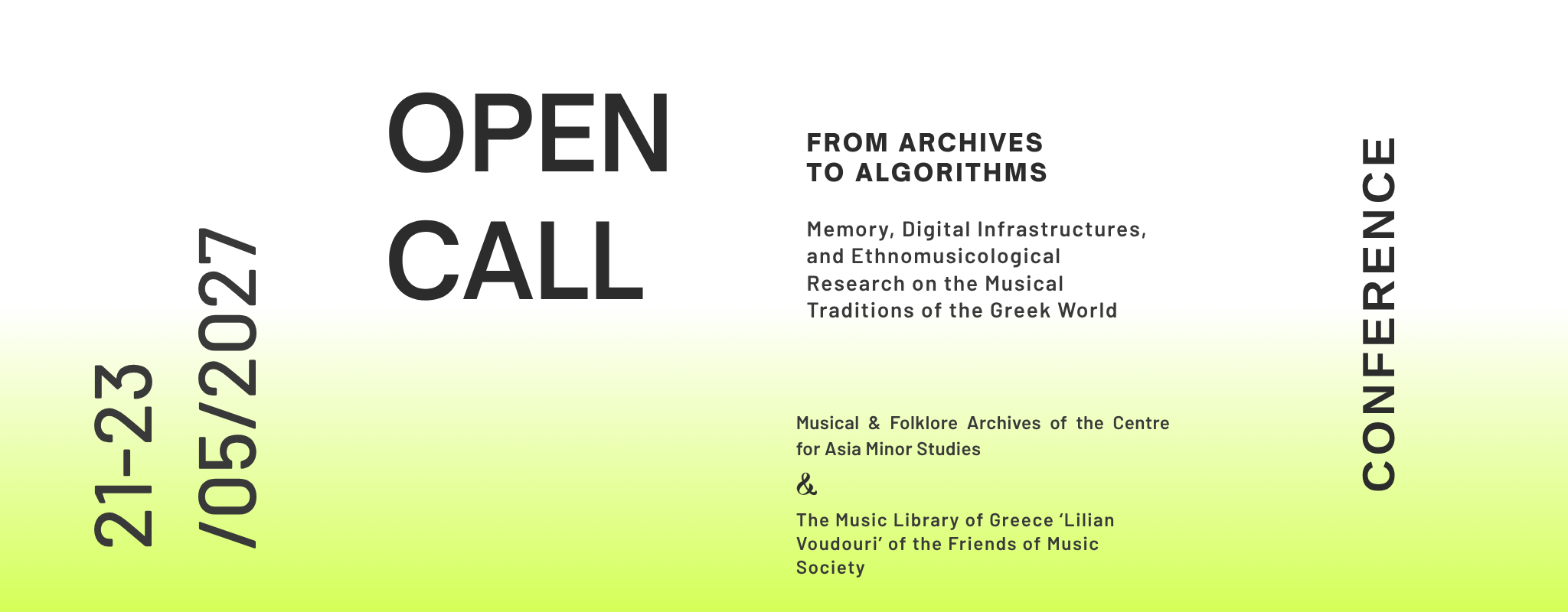
From Archives to Algorithms: Memory, Digital Infrastructures, and Ethnomusicological Research on the Musical Traditions of the Greek World
The Musical & Folklore Archives of the Centre for Asia Minor Studies and the Music Library of Greece ‘Lilian Voudouri’ of the Friends of Music Society invite submissions for an international conference dedicated to examining the present state and future directions of research on the traditional and urban musical cultures of the Greek world.
Over the past century, music archives have served as fundamental infrastructures for the documentation, preservation, and interpretation of musical traditions. Today, however, they are undergoing profound transformations. The digitization of archival collections, the development of digital repositories, advances in computational methods, and the emergence of Artificial Intelligence are reshaping not only archival practices but also the epistemological foundations of ethnomusicological research. Archives are increasingly understood not merely as repositories of historical materials, but as dynamic sites of knowledge production, public engagement, collaborative research, and cultural innovation.
The conference seeks to foster critical dialogue on the evolving role of music archives in the study of the musical traditions of the Greek world, while exploring broader methodological, theoretical, technological, and ethical questions concerning the documentation, interpretation, and circulation of musical heritage in the twenty-first century.
The year 2027 marks nearly one hundred years since the landmark field recording project initiated in 1930 by the Greek Folk Songs Association, the precursor of today’s Musical & Folklore Archives. Conducted under the scientific direction of Hubert Pernot and curated by Melpo Merlier, these recordings constitute the first systematic attempt to document the musical traditions of the Greek world through scholarly field recording. Undertaken only a few years after the Asia Minor Catastrophe and the compulsory population exchange between Greece and Turkey, the project reflected a broader intellectual effort to document cultural memory during a period of profound social and political transformation. It also laid important foundations for the development of ethnomusicology in Greece.
A century later, the conditions under which music is created, transmitted, documented, and studied have changed dramatically. Migration, global cultural flows, digital technologies, online platforms, computational analysis, and Artificial Intelligence are redefining concepts such as memory, community, authenticity, participation, and cultural heritage. At the same time, archival collections are becoming increasingly interconnected through digital infrastructures, opening new possibilities for interdisciplinary research while raising important questions concerning representation, ethics, intellectual property, and public accessibility.
The conference welcomes contributions addressing historical, ethnographic, theoretical, methodological, computational, archival, legal, and practice-based perspectives. Particular emphasis is placed on interdisciplinary dialogue among ethnomusicology, anthropology, musicology, archival studies, digital humanities, music information retrieval, heritage studies, history, media studies, and related disciplines.
Themes
Submissions may address, but are not limited to, the following thematic areas:
1. Music Archives, Folk, Urban Folk-Popular, Popular, and Cultural Memory
• Music archives and the documentation of the musical traditions of the Greek world
• Archives as sites of cultural memory and heritage-making
• Politics of tradition and archival knowledge
• Ideological and epistemological dimensions of collecting, documenting, and classifying music
• Archives and the production of ethnomusicological knowledge
2. Documentation, Digitisation, and Digital Infrastructures
• Digitisation and long-term preservation of music collections
• Metadata standards, documentation practices, and interoperability
• Linked Open Data, semantic technologies, and knowledge organisation
• Digital repositories and research infrastructures
• Computational approaches to music archives
• Artificial Intelligence and Machine Learning for music analysis, classification, transcription, retrieval, and discovery
• New forms of access, listening, dissemination, and public engagement
3. Methodological and Theoretical Perspective
• Ethnomusicological approaches to archival research
• Interdisciplinary methodologies
• Collaborative, participatory, and community-based research
• Relationships between researchers, archives, cultural institutions, and music communities
• Contemporary theoretical perspectives on traditional and urban popular music
4. Musical Traditions and Social Transformation
• Tradition, modernity, and globalisation
• Migration, displacement, refugee experiences, and diaspora
• Rural and urban popular musical cultures
• Musical networks, cosmopolitanism, and transcultural exchange
• Authenticity, reviPval, folklorisation, and heritage-making
5. Sound Recording, Recorded Music, and Technologies of Documentation
• Historical field recordings
• Commercial recordings as sources for ethnomusicological research
• Recording technologies and changing listening practices
• Sound industries, media, and the circulation of musical styles
6. Ethics, Law, and Politics of Archival Research
• Representation, inclusion, and access
• Safeguarding intangible cultural heritage
• Copyright, intellectual property, and rights management
• Community archives and participatory documentation
• Ethical challenges in digital and AI-assisted archival research
7. Creative and Public Uses of Music Archives
• Archives as spaces for research, education, and cultural practice
• Artistic reinterpretations of archival materials
• Exhibitions, publications, digital platforms, and public humanities
• Archives as sites of public dialogue and cultural reflection
The conference aims to create an international forum for critical discussion on the changing relationships between archives, technology, musical traditions, and cultural memory. By bringing together scholars, archivists, musicians, information scientists, and cultural practitioners, it seeks to explore how archival collections can continue to inform ethnomusicological research while responding to the methodological, technological, and societal challenges of the twenty-first century.
Formats
The conference welcomes proposals for:
- Individual papers (20 minutes)
- Thematic panels (3–4 presenters)
- Poster presentations
- Roundtables
- Workshops (methodological or technological)
- Artistic and sound-based presentations
The Conference is part of a series of events organized to celebrate the 30th anniversary of the founding of the “Lilian Voudouri” Music Library of the Friends of Music Society.
The Conference is dedicated to the memory of musicologist Markos F. Dragoumis (1934–2023).
Submission Guidelines
Individual proposals should include an abstract of no more than 300 words and a short biography (maximum 150 words)
Panel proposals should include: a panel description (maximum 500 words), individual abstracts for each paper
and short biographies of all participants
Submission deadline: 10 December 2026
Submit your proposal via e-mail: mla@kms.org.gr